For the sake of auld lang syne, I'm reprinting a rather popular post from the Eggplant's first year, 2007, on what Italians do for the holiday. When I first wrote the post I said that the lentils should preferably represent euros, due to their relative strength four years ago ... now we're not even sure the euro will survive.
New Year's in Italian is Capodanno, and one wishes a Happy New Year by saying Felice Capodanno (especially if it follows Buon Natale), or Buon Anno (more common if alone, that is, after Christmas). December 31st, New Year's Eve, is referred to as San Silvestro.Of course, there are the usual fireworks, and some regional habits, such as throwing everything old out the window. The Neapolitans are especially fond of this, and specialize in getting rid of objects that make a lot of noise when they land, such as plates and glasses. Games may be played, such as tombola (TOME-boh-la) i.e. bingo.
But as you might imagine, food and drink are the main attraction. Sparkling wine is drunk, either (ahem) Champagne, Asti or Prosecco. They may have a cenone, literally, a big dinner, or just appetizers with drinks.
The most entrenched tradition calls for eating lentils with one of two porky products known as cotechino and zampone. The latter are the product of a desperate siege of Mirandola near Modena in the Renaissance, and if you ask me, it shows. Why else would anyone eat dubious porcine matter in pigskin (cotica) or even worse, the skin from the pig's trotter (zampa, so that zampone is literally big paw)? One way of looking at it is if you start the New Year by eating a big pig paw it can only get better thereafter. The traditional accompaniment, aside from the lentils (which symbolize coins, preferably Euros, and thus prosperity), is mashed potatoes. The sliced piggy parts are often placed on a platter and arranged artistically with the potatoes surrounding it.
I first noticed this was available a few weeks ago on Netflix streaming, but it did not immediately appeal to me. But yesterday it was named by both Boston Globe movie critics as one of the 10 best movies of the year, so I decided to watch. And in fact I watched it twice.
Director Frammartino is based in Milan but is originally from Calabria (the "toe" of Italy). And the Greek philosopher and mathematician Pythagoras also lived in Calabria, where he started a religious sect that believed in reincarnation, among other things. And this seems to have been the inspiration for the director (who also wrote the "script"- the movie has no dialogue, or soundtrack).
What happens in this unique film is that we start with an old goatherd who dies and comes back as a kid (in the photo), who then also dies under an evergreen tree; the tree is then chopped down and eventually the wood is turned into coal. The goatherd, the kid, the tree and the coal are the four times (le quattro volte). Further, the movie started with the superstitious old man mixing the sweepings from the church (presumably from burning coal from heating) into a drink for his ailing health, and the movie ends with the coal being sold for fuel in the goatherd's small town, with a final view of the smoke escaping the chimneys.
An extra is the location in Calabria, an area little-known by tourists. The stark and rather forbidding scenery emphasizes the timelessness of the story and the difficulty of the generations who survived such conditions. Religion, from Pythagoras's beliefs to Christianity, with a good amount of paganism thrown in, is central to the work. Of particular symbolic importance are wood and wood crosses or cross-like structures.
The movie has received well-deserved praise, from The New York Times to The Guardian, and elsewhere. While not a masterpiece in my opinion, it bodes very well for the future of director Frammartino, who is only on his second film. Highly recommended.
I'm coming out of my holiday hibernation for a good reason. Right after finishing the movie Le quattro volte (which I'll be reviewing shortly) on Netflix, I sauntered over to the site of La Repubblica to see what, if anything, was going on in the world this boring Christmas day (Christmas on a Sunday, the double whammy). To my surprise I found the large headlines announcing the death of writer and journalist Giorgio Bocca.
It shouldn't have been a surprise as Bocca was 91. But he was one of those people who you don't think of as dying, due to their enduring vitality, lucidity and youthfulness. I've read a lot of his work, and it has influenced me greatly in my perception of contemporary Italy.
Bocca was from a small town in Northern Italy and identified strongly with his origins all his life, being among other things critical (in a politically incorrect way) of Southern Italy and of all the stereotypical faults of Italians, to the point of calling himself "l'anti-italiano." He had a special distaste for all Mafias, and for fascism. In his long and prolific career, he addressed practically everything you can imagine about politics, trends and events in post-war Italy (he was in the Resistance during WWII).
Little is available in English from his vast production, but if you read Italian you will find that he has a direct and engaging style, and is not difficult. You can begin by looking up his byline online, and choose from one of the many topics he pursued. Here is a good selection to start you off. From there, you can perhaps explore one or more of his books. Not to be missed if you have an interest in the real and not just the tourist Italy.
Yesterday I presented the results of best panettone from two Italian publications, and found that the Tre Marie cake was the winner.
But as I also stated at the end, I actually prefer pandoro, a similar baked product, but with a softer, more compact interior, and no dried fruit and stuff. The pandoro may have a filling.
Results as given in today's La Repubblica (taken from the consumer publication Il Salvagente) inform us that Tre Marie was also the best pandoro.The complete results are in this table. Again, I've never tried the Tre Marie brand, but I have had Bauli more than once, and thought it was good. Bauli (BOW-lee) will be a lot easier for you to find than Tre Marie.
Due to the relative plainness of pandoro, it is sometimes served with a light sauce, based on cream, zabaione or mascarpone.
So Tre Marie takes the cake. Actually, it takes two cakes, panettone and pandoro.
Other Italian baked products associated with the season are panforte and panpepato, vaguely similar to fruitcake. Many are not enthusiastic about these, but I rather like them. Not for the uninitiated, more of an acquired taste.
I went looking online and found two Italian consumer publications from recent years that review panettone. Both came up with the Tre Marie brand as their number one choice.
The first source, Altroconsumo, stated in 2010 that only Tre Marie (as an industrial and not artisanal product), measured up to their exacting criteria, all the others failed. In 2009, another publication, Il Salvagente, also gave Tre Marie a number one ranking, but also gave high marks to Motta, the most famous brand.
I can't personally substantiate these results, as I've never had the brand. Actually I prefer pandoro.
What are these Latin words doing on my Italian blog? OK, the Italians are the descendants of the ancient Romans, but they're not really ancient Romans (no matter what some of them may think). But like us, they evidently got much of their judicial infrastructure from the Romans.
These ancient words are actually quite topical, both in Italy and the US. What they refer to is no less than the basis of someone's national identity. Jus soli is literally the law of the soil: the basis of citizenship is the land, that is, where one was born, for whatever reason. With jus sanguinis (literally, law of blood), citizenship is determined by "blood," that is, ethnicity or kinship.
For obvious reasons, the US, which started as a new country with a heterogeneous population, adopted the law of the soil, so that you are an American if you were born here, even if your mom got here the day before. Italy, which is an old country with a homogeneous population, uses the law of blood, so that you are Italian if you are ethnically Italian. I, for example, although born in the US from an American father, am eligible for Italian citizenship because I have two Italian grandparents and my Italian-citizen mother was a citizen when I was born. Italians do in fact consider me Italian, and merely specify that I was born in America, as if it were some sort of accident (or misadventure).
These are over-simplifications, of course. But it should come as no surprise that our rapidly (too rapidly) globalizing world is making these categories hard to sustain. At this time in history, many Americans are questioning the law of the soil because of abuses by immigrants (often illegal) who seek a foothold here by having children. Some are seeking repeal of the birthright clause of the Fourteenth Amendment. Ironically, some Italians are now questioning the law of blood, due to the high numbers of assimilated immigrants (many of them of color and many of them born in Italy). Widely-respected President Giorgio Napolitano has recently called for a repeal of the law of blood.
These seem to be theoretical, legalistic matters, but they are of practical importance to millions throughout the world, and may well define the nature of our world in the decades to come. A human face can be put on the question by the story of superstar soccer player Mario Balotelli, a (very) black young man born in Italy to Ghanaian parents, and later taken into foster care by Italians. He is now a citizen. The 21-year-old has confronted considerable anguish in his short career by Italians harassing him at the stadium and online with racists taunts and asserting that you can't be black and Italian. He now plays in England.
Above you see a video put out by ARCI, a left-leaning organization that supports Napolitano's position on birthright citizenship in Italy. It provides a timeline of the life of young Davide, born in Italy and doing all the Italian stuff, liking riding a Vespa as a teen. It then shows that when he comes of age he is brutally informed that he is not Italian and he has 12 months to show that he is.
Listen up, students of Italian, this is important.
You often hear that so-and-so is "fluent" in one or more foreign languages, as if this were the hallmark of language acquisition. Well... it isn't, necessarily. Fluency involves fairly rapid and unbroken delivery of speech. This doesn't always imply that the language delivered is grammatical, with a well-developed vocabulary, or even comprehensible in terms of pronunciation.
Accuracy and fluency tend to have an inverse relation in language delivery (when one goes up, the other goes down). It is not hard to see why: if you are not self-monitoring and hesitating to find the right word or correct syntax, you can speak much more quickly. The ideal of course is to have both accuracy and fluency, but this is achieved (when it is achieved) at a late stage.
In my experience, there are various factors that determine whether accuracy or fluency will prevail at a given time with a given speaker. One of these is personality (those who are shy will be more accurate), another is gender (men often are fluent to the detriment of accuracy), and also life experience (those who must speak for practical purposes are more fluent and less accurate, those whose knowledge was acquired academically are more accurate).
Language learners should strive for both, although accuracy should prevail in the early stages- if one gets used to mistakes in grammar, vocabulary and pronunciation, they will be harder to eliminate later. Once a solid basis has been attained (intermediate, upper-intermediate level), one should focus on fluency.
Not many know this, but at a certain point, under the influence of his BFF Benito Mussolini, Hitler wanted to become Italian. He considered the various typical occupations for an Italian: pizzamaker, mafioso, Renaissance man, fashion designer, saint... He finally settled on opera singer.
Alas, as you can tell from the video, his artistic endeavors in music met with the same degree of success as his attempts as a painter.
Transparency International has been compiling statistics on countries' corruption for years now, and for years Italy has made a figuraccia (a terrible showing). 2011 is no exception.
Although one may be skeptical of these organizations, their agenda, and the resulting data, Italy's abysmal rating is fully consistent with what I observed first-hand in twenty years in Italy. Which is why I no longer live there, nor would I return.
The countries that do best, as usual, are the Scandinavian countries. My own country, the United States, does much better than Italy, but not as well as one might expect, and this is also in line with my experience.
Quick- where is the above located? Amsterdam, Singapore, Omaha? No, Italy.
Why weren't you able to tell where it is? Easy, it's a mall. And they're all alike. And that ain't good.
Yes, the so-called holiday season is upon us. We've just been through Black Friday (for non-Americans, the day after Thanksgiving) and Cyber Monday, both dedicated to the noble art of shopping and over-consumption. As if we didn't over-eat and over-buy all year long, we have to top it off toward the end of the year.
I was still living in Italy when they started to have malls, called centri commerciali, twenty years ago. They used to be a rarity, but now they're all over the place. In examining this phenomenon in Italy, I turned to the Internet and forums where Italians speak their mind. More than one person expressed the sentiment (?) that the mall was a good place to go on Sunday when you didn't know what else to do.
Can you imagine living in Italy and not knowing what to do on your day off? You must be an idiot.
Well, that's enough for my holiday rant. Italian malls- what an idea.
Don't know Mina? You're in for a treat. Reportedly, Louis Armstrong said she was the greatest white female singer, and I don't want to argue with Louis, where music is concerned. And she was certainly easy on the eyes. Mina is surely the most popular woman singer in Italy of the last half century, and she continues to be active. The music is by none other than the renowned Ennio Morricone.
For those of you who are studying Italian, this will also be a work-out. You have the gerund (or -ing form) and hypothetical ("if" sentences) of the second type.
The recent appointment of Mario Monti as Italian prime minister has already given rise to a slew of puns and other word-play on his name (which means "mountains," and in fact he is from Varese near the Alps.) An obvious one I've already seen a few times is "the Full Monti." I'm sure there will be others.
But let's look at the expression mare e monti: sea and mountains. It's easy to see why such an expression would be common in Italy, whose geography is dominated by highlands and the sea, sometimes in close proximity (as in the coast of Tuscany). Historically, Italians have taken their vacations at the seaside (most of them) or the mountains/hills, to get away from the heat. They still tend to do this, even with the advent of air-conditioning, of which they are rather afraid. Yes, Italians still mistrust air-conditioning, fans (especially at night, blowing on you when you sleep), open windows and drafts (even in August), and ice in their drinks.
Last but certainly not least is the gastronomic term mare e monti to indicate a dish which includes ingredients from the sea and from mountains or hills. These are sometimes dishes that feature meat and fish (like our "surf and turf" in the US), or they include seafood and say, mushrooms or even truffles (yum). I personally am partial to the shrimp and mushroom combination, as seen in the photo.
Mario Monti has been appointed as the new Italian prime minister. I have great respect for Professor Monti and think that if he is allowed to do his job without the usual political encumbrances, we can expect important improvements from his leadership. But we can't expect him to muovere mare e monti (to move the earth and sky- literally, to move the sea and mountains). Maybe just the monti.
Some of you may have been following the (not very good news) in the Italian media. Of course we know they like to use English words. So what is this spread they're talking about with alarming frequency?
I'm glad you asked. The financial term "yield spread" refers to the difference in rates of return between investments. In this case, it is the difference between the yield of Italian government bonds (buoni del Tesoro or BTP) and the corresponding German bonds as measured in points. This is an indication of the relative strengths of the respective economies. Today the spread was at 553 according to Repubblica and 575 according to Corriere, both record highs.
As of this writing, Berlusconi is on his way out and well-respected economist Mario Monti may be in. You will be pleased to know that Monti is about as far from Berlusconi as one human being can possibly be from another. There is a considerable spread, not to say abyss, between the two men.
Well. I'll tell ya. For some Europeans, including Italians, November 11th, which is upcoming, is also supposed to be in the midst of a period of time characterized by mild, beautiful weather. A sort of reprieve from the awful meteorolological events just around the corner.
In the Unites States we call this "Indian summer." Some furriners (for example, the English) have adopted this term despite the absence of Indians (American Indians, not Indians from India) on their territory.
So why Saint Martin? November 11th is the name day of Martin (in Italian, onomastico).
Whatever you call it, here or in Europe, I am thoroughly enjoying this wonderful respite from the usual New England weather.
La pesca (see left), is a peach, that is the fruit. Il pesce (masculine noun) is fish. To further confuse matters, the noun la pesca can also refer to fishing. And il pesco is the peach tree. Got that?
I know, lots of Italians are scary- but this time I mean those who are intentionally scary. Namely, the masters of Italian horror films. Italians have a thing for horror- for example, like the French, they are great admirers of Edgar Allan Poe.
Celebrate Halloween (which has been "observed" in Italy for about ten years now) by checking out these cult favorites. Here are the names of the most famous directors of Italian horror movies: Dario Argento, Riccardo Freda (who once visited my home in Padova with his large dog), Mario Bava, Lamberto Bava (his son), Lucio Fulci, and others. Find out more here.
Many of these can be found on Netflix streaming, if you look carefully enough.
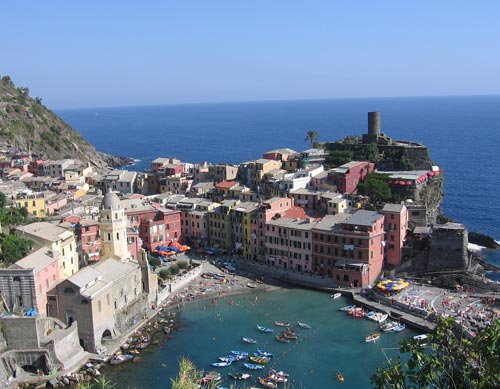
The Cinque Terre is an area of Italy in Liguria (in the North West), along the sea. It literally means "five lands" and is comprised of the lovely villages of Vernazza (in the photo), Monterosso, Manarola, Corniglia and Riomaggiore.
This week's flooding in Italy has hit the area particularly hard. For more info, see this article in The Guardian.
They (it's always "they") inform us that by the end of the month the earth's population will reach seven billion. If you want to bandy about this alarming fact in Italian, you will use the word miliardo.
"Billion" means a thousand million. Incredibly, it wasn't too long ago that the British used "thousand million" for "billion," and used "billion" for our "trillion." They eventually awoke to the folly of their ways, and adopted what is called the short scale. People don't even understand these quantities when they are consistent, and having two confusing systems for them might possibly lead to millions, or billions, or even trillions of mental breakdowns worldwide.
Until the recent adoption of the euro in Italy, the word "millionaire" was translated by the word miliardario, due to the strong inflation of the lira. It is now back to milionario, as it was in Italy many decades ago.
This was a great disappointment. Considered by some to be one of the best movies of all time and the best Western, I consider it neither. Mind you, it has very high ratings on all sorts of sites, a cult following and it has influenced a number of filmmakers.
Looking for a clip to feature on this post, I became bored all over again when I started to watch the above, a part of the opening sequence. I loved Leone's Dollars trilogy, especially The Good, the Bad, and the Ugly, and I love Westerns, but I didn't like this at all.
Too long. Over two and a half hours. Too slow. Too confused. Did not care about characters. Plot not compelling. Excessive and gratuitous violence.
Strange that a movie with so much talent (and so much money from Paramount), with the direction of Sergio Leone, story by Leone, Bertolucci and Dario Argento, cinematography by Tonino Delli Colli, and major actors such as Henry Fonda, Charles Bronson and Claudia Cardinale, did nothing for me. I didn't even particularly like the score by Morricone. Anyone who has seen High Noon or Shane and then says this is the best Western ever makes no sense at all.
But check it out for yourself; it is now available on streaming through Netflix.
To celebrate the untimely (in the sense that it was long overdue) departure of Qaddafi, here is a 1986 song from Gianna Nannini, apparently inspired by none other than the late colonel.
It's been a long time since Qaddafi was bello (handsome) and as of yesterday, he will no longer be impossible, either.
The irrepressible Gianna, who is a lesbian, recently gave birth to her first child, Penelope, at the tender age of 54. She is part of the Nannini family of Siena, famous for their wonderful pastries. Gianna started working as a teen in dad's business, but lost two fingers while operating a machine. This certainly put her off from continuing in the family line, and she made an abrupt career change.
Andrea Zanzotto, widely considered one of the major contemporary poets, has died shortly after his ninetieth birthday. He was a Veneto boy from Treviso, not far from Venice.
Here is a selection of his poetry (in Italian and dialect).
"Nero is here, Rome is burning." This is one of the graffiti on the walls of Rome after yesterday's demonstrations/riots. Unlike other October 15 Occupy Wall Street events, Rome's turned very ugly, as can be seen in the video from La Repubblica. There was apparently an infiltration by the radical and violent "black bloc," who quickly attacked storefronts (mostly of banks) and set fire to cars and even one Carabinieri van (with a Carabiniere inside, who managed to get out.)
There is an awful lot of discontent in Italy, much of it justified. It remains to be seen where this new movement will go, or if it will just be the latest in a series to show that in Italy (in the words of Tomasi di Lampedusa) "everything must change so that everything stays the same."
Who can resist truffles and/or porcini mushrooms? Not me.
So today, being in the mood for self-indulgence, I acquired this small (6.1 ounces) can of white truffle and porcini cream sauce. It didn't come cheap, of course; it set me back thirteen dollars.
But it was delicious right out of the can onto the pasta (Delverde tagliatelle), with a bit of extra salt and freshly-ground black pepper. The can is enough for two medium-small portions of pasta. It can also be used on bread, crostini and according to the producer itself, with meat or fish. But I would limit myself to the first two options.
Urbani is a well-established company based in Umbria, but has had a presence in New York for over a year now. Their site is here.
Italians undeniably have one of the best cuisines of the world, so it took them a long time to warm up to non-Italian foods. Among the very first instances of a foreign culinary presence were Chinese restaurants, and I can remember back in the day (the 80's) when even Chinese food was hard to come by in Italy. Back in the day, it was hard even to get a decent hamburger.
No more. Along with the teeming hordes of immigrants, Italy now has a variety of ethnic offerings. Not so much as in the US or some European countries, but an interesting diversity. So much so that kebabbaro has entered into common parlance, for a place/person selling kebabs and other Middle Eastern goodies.
From time to time, some Italian local government forbids ethnic eateries within the city limits, as Forte dei Marmi in Tuscany did recently, with the justification that these businesses have nothing to do with the local culture. Hmmm- what if the whole world outside Italy forbade pizza and spaghetti? Quandaries of the multicultural society.
In case you haven't been paying attention, Yelp is an online service which publishes ratings and reviews about businesses, and sometimes other entities, produced by real people who have used or experienced what they're writing about. It is having great success and I often consult it.
So now, following the lead of other foreign countries such as Germany and Britain, Italy has just brought out its own version, Yelp.it. For now it only features reviews in Rome and Milan, but the listings are already there for other cities (without reviews as yet).
It's in Italian only. As it's written by Italians or at least people who have visited and know Italian, it potentially represents an interesting and valuable resource for travelers. Check it out.
Everyone aspires to go to Venice at least once, and that includes birds and cats. Here we have world-famous Tweety bird and his enemy, Sylvester the cat, in that beautiful city.
Of course the Italians know all about our popular American culture, and that includes adorable Tweety and his wannabe nemesis. They call them Titti (don't snicker) and Silvestro.
Here we have the immortal pair in Venice. Tweety is his American self (with Granny, of course), but Sylvester is Italian. In the upper video, the original, you see Tweety singing Santa Lucia in a competent way (birds will sing). Italian Sylvester plots against him, as usual, and loses, as usual.
In the lower video, the Italian version, you see that instead of strictly translating they have re-interpreted. Italian Silvestro thinks that Tweety must be American since he is singing a Neapolitan song in Venice. He also thinks the little bird will go well with polenta, according to the local (now illegal) dish poenta e osei. Later Silvestro reluctantly admits that Venice is Italian after all, and as an Italian cat he should of course be eating spaghetti. He tries to lasso Tweety with a string of spaghetti- but of course Granny comes to the rescue.
It has come to my attention that many of you out there have not mastered the imperfect tense in Italian. Even some who have been studying Italian for years. Obviously I cannot allow this situation to continue.
Why all the problems? Perhaps English speakers are put off right away by the very term "imperfect." They might be distrustful: why would anyone want to mess with something that openly admits to not being perfect?
But the word "perfect" in grammar does not mean the same as in common speech ("flawless"). "Perfect" in grammar means that an action has been completed within a certain time frame. And here we have a good clue as to what the function of the imperfect is. The imperfect describes an action in the past where the action was continued or habitual, and where the emphasis is not on the specific time frame but on the fact that the action continued or was habitual. This is why phrases with "used to" or "would" to describe this sort of thing take the imperfect in Italian. Unfortunately, many sentences where you would use the simple past in English will use the imperfect in Italian.
Let's take a look at some sentences, comparing the use of the imperfect and other past tenses.
Dov'eri ieri? Ti ho chiamato tutto il giorno.
Where were you yesterday? I called you all day long.
I know, I know. Why isn't the second part in the imperfect? Because the calling all day is within the specific time frame of yesterday, whereas the person's being somewhere was indefinite. Were they gone all day? In the morning only? For six hours? Not important.
Stavamo mangiando fettuccine ai funghi quando la polizia ha fatto irruzione.
We were eating fettuccini with mushrooms when the police raided us.
Here is a common use of the imperfect: two actions happening at about the same time, with one happening for an indefinite amount of time (imperfect) when another action, at a definite time (passato prossimo here) occurs. Mentre(while) is often used in the clause with the imperfect.
Here's another example of this:
Mentre leggevo The Smiling Eggplant mi e' esploso il computer.
While I was reading The Smiling Eggplant my computer blew up.
Another case:
Aveva dodici anni quando divenne apprendista di Bellini.
He was twelve when he became Bellini's apprentice.
Here the first phrase uses the imperfect because it speaks of any time during the year the person was twelve. When it was isn't important, the fact that he was a twelve-year-old is important. The other verb is a passato remoto.
Stavo male domenica.
I didn't feel good Sunday.
Yes, this is a specific time frame, but the emphasis is on the continuing state of feeling bad and not so much on the Sunday part.
A very common usage:
Quando vivevo a New York uscivo spesso.
When I lived in New York I went out a lot.
Notice that "used to" is implicit here ("when I used to live in New York I used to go out a lot".)
When "used to" and "would" are used in English to express habits or repeated actions, use the imperfect in Italian.
Cercava sempre di imbrogliarci.
He was always trying to/he would always try to cheat us.
Da ragazza andavo sempre a ballare.
As a girl I used to go dancing all the time.
This usage won't come easily to you right away, but notice from now on when you see or hear the imperfect how and why it is used.
These are large, flat rectangles, closer to ravioloni (big ravioli) than regular ravioli (by the way, never say "raviolis," the word is already plural.) They're filled with an artichoke/cheese/olive mixture.
Let's cut to the chase. They were good, but not great. Not a big fat artichoke taste, which is something of a disappointment, as artichokes are my favorite veggie. The price was good, as is so often the case at Trader Joe's. I don't know where the receipt is so I can't tell you exactly how much. I think you would need a package per person if serving as a main course.
I prepared mine with butter and real parmigiano. I would avoid a richer sauce or a tomato sauce as they would overpower the flavor of the stuffing.
The package also gives intructions to stir often. Better to cover instead after they have reached a gentle boil so as not to risk breaking the shell. Drain well.
I remembered hearing somewhere that Lincoln had wanted Giuseppe Garibaldi to be a Union general, but I was rather skeptical of this whole thing and then forgot about it.
But as part of its Civil War series this year, the New York Times has an article that in fact confirms that Garibaldi was approached on the island of Caprera in the summer of 1861, after the rout of the North at the First Battle of Bull Run. He was tempted, but apparently wanted reassurance that the war was fought to liberate slaves, and that it was not "merely" a war to maintain national unification. Although he evidently thought that unification was reason enough to fight for Italy, which reached that goal precisely in 1861. Maintaining the Union was something that at best foreigners were indifferent to, and at worst hostile to, because of the implications for the balance of power worldwide- an enormous, rich, and strong country was not what they wanted (but it is what we, and they, got in the end). Lincoln may have wanted Garibaldi's participation as much as a public relations feat as a real military boost to his Army, due to the great popularity of Garibaldi.
Obviously Garibaldi did not join the Union ranks, but his vacillation points out the ambiguity in our own motivations. Was the war a war fought for power and supremacy? Did Lincoln finally sign the Emancipation Proclamation mostly as a strategic move to destabilize the South (and to get some black troops)? I tend to think that the dichotomy of "preserving the Union" and "liberating the slaves" is a false one. The country envisioned by our Founding Fathers was not one that could countenance an entire "civilization" within its borders based on grievous social injustice, backwardness, and feudal privilege. Garibaldi should have joined.
Virtus Bologna has offered NBA player Kobe Bryant 6.7 million dollars to play in Italy, with the option to get out if the lockout is discontinued. Whatever a lockout is, I'm pretty sure it means they're not playing, maybe it's some sort of strike. Don't people usually strike for better conditions? What, are the NBA players playing too many minutes for too few millions?
Will he or won't he? Kobe grew up partly in Italy and is fluent in the lingo (see video), although a bit rusty. Read more about it at this Huff Post article.
The (unfortunately) irrepressible Silvio Berlusconi recently made a disparaging remark about the feminine charms of German Chancellor Angela Merkel. To be precise, he called her a culona inchiavabile, an unfuckable fat ass. This of course is in line with his usual refinement and tact.
In the video, we see comedian Maurizio Crozza impersonating Merkel and answering her distinguished Italian colleague. At the end of the video, she asks if they have put asterisks in the obscene words. Then she specifies that culona inchiavabile is not the obscene part (nein, nein, nein, nein, nein!), but "Berlusconi" is. Danke schoen!
I must not have been paying attention, but I just found out that while the euro bills are the same throughout the Eurozone the euro coins have one side that is the same and the other side that is individualized by country.
The Italians have the coolest national figure. They chose Leonardo's Vitruvian man, as you can see on the left. To find out more about this, read this bilingual article here.
To see pictures of the various national euro coins, go to this site.
Here's our proverb of the week- chi e' surdu orbu e taci campa cent'anni impaci (chi e' sordo, orbo e tace campa cent'anni in pace). He who is deaf, blind and mute lives in peace to be a hundred. The Southern Italian proverb expresses the quintessence of omerta', or organized crime's code of silence. As such I think it is contemptible; far from expressing any notion of loyalty or even prudence, it is a justification of cowardice.
Here is a whimsical 1960 tune from legendary singer-songwriter Gino Paoli (lyrics written by Mogol, who would later work with Lucio Battisti). It apparently alludes to Paoli's starving-artist-in-garret period, populated by a music-loving (female) cat and a visiting star (of the astronomical sort). Lyrics and translation follow. Students of Italian will note the use of the imperfect for habitual situations in the past that no longer exist.
C'era una volta una gatta che aveva una macchia nera sul muso e una vecchia soffitta vicino al mare con una finestra a un passo dal cielo blu. Se la chitarra suonavo la gatta faceva le fusa ed una stellina scendeva vicina vicina poi mi sorrideva e se ne tornava su.
Ora non abito più là tutto è cambiato, non abito più là ho una casa bellissima bellissima come vuoi tu. Ma io ripenso a una gatta che aveva una macchia nera sul muso a una vecchia soffitta vicino al mare con una stellina che ora non vedo più.
Once upon a time there was a cat
with a black spot on her muzzle and an old
attic by the sea with a window
steps away from the blue sky. If I would play my guitar
the cat would purr and a little star
would come down really close
then it would smile and go back up again.
Now I don't live there anymore everything has changed,
I don't live there anymore, I have a beautiful house,
beautiful, as you want.
But I think back to a cat with a black spot on her muzzle, to an old
Long before the famous Italian ("spaghetti") Western movies of the 60's and 70's, including those by the great Sergio Leone, there was Tex.
Tex was a cartoon character cooked up in 1948 by the very un-Western-named Gian Luigi Bonelli and Aurelio Galleppini. Since then the cartoon, aimed mostly at adolescents and grown-ups, has been steadily successful, to the point of being translated in other languages. I was reminded of its existence because currently the newspaper La Repubblica is featuring a special collection on sale with the paper itself.
Interesting that even twenty years of Fascism were not able to stop the fascination Italians have for the West, as the series started only a few years after the end of Mussolini and his hatred of all things English and American. Although I have never read these comics (fumetti) many perfectly intelligent and well-educated Italians do. From what I've heard, it's a compelling mix of the fictional and mythological adventures of the made-up Tex Willer, along with historical scenery, characters and events, including of course the Civil War. I bet you anything Leone and the other spaghetti Western masters were brought up on Tex.
This is a tough one. I can assure you that you will not master the usage of the word ormai just by reading the dictionary, which will unhelpfully give you "equivalents" such as "now" or "by now" ("by then" if speaking of the past) and even "almost."
The word ormai expresses a view or a mood associated with an occurrence or action with reference to time- more specifically, the end or near-end of a lapse of time. There is usually the idea that the passage of time has not been correctly perceived; thus, the mood is often, but not always, one of resignation or a sobering acknowledgement of relative lateness. Let's take a look at some examples:
Ormai i bambini sono grandi.
The children are grown now. (They're not kids anymore, soon they'll be leaving home, we can't tell them what to do, etc.)
Ormai ho capito che tipo e'.
I've finally understood what kind of man he is. (Not a very good kind, I should have caught on sooner)
Sono le undici ormai.
It's eleven o'clock (now). (It's getting late, hadn't really noticed, time to go home/turn in/wind down)
Quell'attrice ha ormai cinquant'anni.
That actress is (now) fifty. (She's getting up there, not as good-looking, harder to find good roles, she'd better face up to it)
You'll be pleased to know ormai is not always so wistful or mildly depressing.
Siamo arrivati ormai.
We're practically there. (Said for example to whining children on a trip)
Ormai e' fatta.
It's done now. (It's finally finished; may also suggest irreversibility, which again is mildly depressing)
Ormai sara' arrivato a casa.
He should be home by now.
In its resignation mood it can even be used alone.
-Perche' non ci provi un'altra volta? -Ormai...
-Why don't you try again?
-No/It's useless/It's too late
One of the most famous and glorious Neapolitan songs was actually written in America. Core 'ngrato (Ungrateful heart), also known as Catari' (after the name of the cruel lady) was written in the States one hundred years ago by Italian immigrants Salvatore Cardillo (music) and Riccardo Cordiferro (pseudonym of Alessandro Sisca, lyrics).
First we'll look at the lyrics in the original Neapolitan, then I'll translate into standard Italian and then English. Finally, we'll examine a mini-mystery about Caruso's version of the words, which differs from others'.
Catarí', Catarí'...
pecché mm''e ddice sti pparole amare?!
Pecché mme parle e 'o core mme turmiente Catarí'?!
Nun te scurdá ca t'aggio dato 'o core, Catarí'...
Nun te scurdá...
Catarí'...
Catarí', che vène a dicere
stu pparlá ca mme dá spáseme?
Tu nun ce pienze a stu dulore mio?!
Tu nun ce pienze, tu nun te ne cure...
Core, core 'ngrato...
T'hê pigliato 'a vita mia!
Tutto è passato...
e nun ce pienze cchiù.
Catarí', Catarí'...
tu nun 'o ssaje ca fino e 'int'a na chiesa
io só' trasuto e aggiu pregato a Dio, Catarí'...
E ll'aggio ditto pure a 'o cunfessore: "Io stó' a murí
pe' chella llá...
Stó' a suffrí,
stó' a suffrí nun se pò credere...
stó' a suffrí tutte li strazie..."
E 'o cunfessore, ch'è perzona santa,
mm'ha ditto: "Figliu mio lássala stá, lássala stá!..."
Core, core 'ngrato...
T'hê pigliato 'a vita mia!
Tutto è passato...
e nun ce pienze cchiù.
Caterina, Caterina...
Perche' mi dici queste parole amare?
Perche' mi parli e il cuore mi tormenti, Caterina?
Non ti scordar che ti ho dato il cuore Caterina
Non ti scordar.
Caterina
Caterina che vieni a dirmi
Questo parlare che mi da' spasimi?
Tu non ci pensi a questo dolore mio?
Tu non ci pensi, non te ne curi.
Cuore, cuore ingrato
Ti sei presa la vita mia
Tutto e' passato...
E non ci pensi piu'.
Caterina, Caterina
Tu non lo sai che sono andato persino in chiesa
Sono entrato e ho pregato a Dio, Caterina
E l'ho detto pure al confessore, Caterina: "Sto per morire
Why are you speaking to me and tormenting my heart, Cathy?
Don't forget that I gave you my heart
Don't forget.
Cathy
Cathy what are you saying?
This talk is torture to me.
Don't you think of my pain?
You don't think about it
You don't care.
Heart, ungrateful heart
You've taken my life
Everything has passed
And you no longer think of it.
Cathy, Cathy,
You don't know that I even went to church
I entered and prayed to God, Cathy
And I even told the priest, Cathy: "I'm about to die
for her,
I'm suffering
Suffering that is not to be believed
I'm suffering every kind of hell
And the priest, who is a holy man said: "Son, leave her alone, leave her alone."
Heart, ungrateful heart
You've taken my life
Everything has passed
And you no longer think of it.
Above you have two versions of this sublime song. The first is by the famed tenor Enrico Caruso, the second by the late great Neapolitan singer Roberto Murolo.
Caruso's version, which is perhaps the original, changes the second part when he is in church and doesn't mention the priest (but he does mention praying to God). No other version I have heard, including Murolo's, is like this. Further, I can't quite make out what Caruso is saying instead of the part about the priest. After some digging, I found that the lyricist Sisca was a radical socialist and deeply anti-clerical, so it is possible that this was his original version. I personally think that the version with the priest is superior- regardless of what one may think of the Catholic Church and its clergy.
Oddly, Cardillo, who wrote the music, was surprised by its enormous success and called it a porcheria (junk). How little he knew. It is now in the standard repertoire of every self-respecting tenor. None of whom, to my knowledge, sing Caruso's version.
Due to the difficulty and expense of finding good pine nuts, the idea occurred to me to use cashews instead. This was also suggested by the abundance of fresh basil in my container garden. Cashews are not common in Italian cooking at all; in fact, the only time I saw them there was in Chinese restaurants.
So how did it turn out? Fine. I made it with my mezzaluna, and not a food processor. I minced the basil, added the cashews, then the fresh garlic, then the freshly-grated parmigiano-reggiano. I added extra-virgin olive oil as I went, tasting for texture and liquidity. Be careful if the cashews are already salted to take that into account. Let me just say that making pesto with a mezzaluna is good (grainy), but labor-intensive.
After I made it, I remembered that the ready-made brand I usually bought in a small jar when I was living in Italy (Tigullio brand) did indeed use cashews (anacardi). And that was also good, and extremely labor-unintensive.
You should not cook or heat your pesto. What Italians will often do is to add some acqua di cottura (the boiling water from the pasta) to dilute the pesto. They will also add a noce di burro (about a teaspoon of butter)to each plate of pasta and pesto to enhance the taste and make it less tangled.
It is a gross over-simplification to say that Italians only use olive oil as their cooking fat. They use other oils and fats, and of course they also use butter (burro, not to be confused with the Spanish donkey). The butter they use is unsalted.
As a rule of thumb, butter is used more in Northern Italian cooking. A good compromise, for health reasons, might be to use half olive oil and half butter. This way you also get the benefit of a relatively high burning point. Butter alone will easily reach the burning point, which is pesky.
For an optimal risotto, I would suggest butter only. This will improve your chances of getting the highly sought-after risotto all'onda, where the mound of risotto on the plate will slide when the plate is tilted.
I would not buy imported Italian butter,there is nothing special about it. Even when I was living in Italy, I actually looked for imported German butter; lacking that, I would try for the butter from the German-speaking region of Alto-Adige.
If you're unused to unsalted butter, give it a try for a few weeks. American-made Land o' Lakes is fine, as is the more expensive Danish Lurpak.
Whatever you do, avoid margarine and butter substitutes. Use less fat overall, but make it real.
Here's another one of my what-I-had-for-lunch posts. Don't be put off if you don't like anchovies; the finished dish does not necessarily taste that fishy.
The original name of this recipe is called bigoli (or bigoi) in salsa. Bigoli are like chubby fresh spaghetti. This dish is from the Jewish Venetian tradition. Originally made with buckwheat, they are now usually made with whole wheat. However, I don't care for whole wheat pasta, so I used my regular De Cecco spaghetti, which is good because the rough surface allows the sauce to cling to it.
OK. I put plenty of water on to boil for the pasta. I did not salt the water because of the saltiness of the anchovies. For one person (actually, one eggplant), I minced a medium-sized yellow onion with my mezzaluna. I put four-five tablespoons of extra-virgin olive oil in a frying pan and added the onion, frying over a medium-high heat. Onions should not brown at any time, so add water or turn down heat to avoid this. After a few minutes I addedthe anchovies (2 ounces), which I had rinsed. I continued to cook the onion-anchovy mixture for about ten more minutes, making sure the anchovies were completely blended and the onions were soft. Toward the end, I mashed the onions with the back of my wooden spoon to make the sauce more paste-like.
I drained the cooked spaghetti and turned them out into the pan with the sauce. I quickly and thoroughly stirred, then added about three tablespoons of fresh minced flat-leaf parsley. I also added some freshly-ground black pepper, but that's optional. It was good, and I'll probably make it again, but it wasn't exceptional. For less of an anchovy taste, I would soak the anchovies for ten minutes. I would also remove the anchovy bones beforehand if you don't like them, because they don't disappear into the sauce as I expected. Don't add cheese.
The dish is inexpensive and convenient, because you can always have onions and canned anchovies on hand. I'm not sure I'd make it for company, because it turns out to have a homely grayish-light brown color.
By the way, if you like anchovies you're sure to like pane cunzato, an excellent summertime pizza alternative. See my recipe here.
I was going to post something serious about the Gini coefficient but then I said, the hell with that. It's August. Let me post something seasonal and appropriate to people's lazy, frivolous mood. For example, something about a 3-kilo zucchini.
And in fact the newspaper of Padova, where I used to live, ran a story of this 80-year-old retiree who cultivates his own little orto (vegetable garden) and came up with this monster zucchini, weighing about three kilos or over six and a half pounds. Unfortunately, the best zucchini are the smaller ones, but maybe the old geezer doesn't know this and let his zucchini get out of hand.
Italians usually call zucchini zucchine (feminine), which is a sort of diminutive of zucca (pumpkin), and in fact zucchini are part of the squash family, so that the Italians see zucchini as a sort of small pumpkin (except in a case like this, where it is close in size to a pumpkin). Isn't that interesting? But as I said, small zucchini are best, avoid the big ones.
All sorts of recipes with zucchini can be found on this blog by using the search function in the upper left corner.
One of my favorite things about Italy (although they are not of course limited only to Italy) are the umbrella or stone pines, pini marittimi (Pinus pinea). Italian pine nuts or pinoli come from this beautiful tree, while Chinese pine nuts (which the Italians frown upon) come from other species. I have also heard that the Chinese pine nuts cause an after-taste for some. A cluster of pines is called a pineta.
The booful umbrella pines shown above are from Bibbona on the Tuscan seaside. Wish I were there right now.
In questi giorni mi prende un po' di nostalgia e la mente torna a Nord-Est, non degli Stati Uniti, dove vivo ora, ma dell'Italia. In particolare, a una delle mie regioni preferite, di cui ho parlato varie volte su codesto modesto (c'e' la rima) blog- l'Alto-Adige, e per non far incazzare (ulteriormente) la popolazione di lingua tedesca, chiamiamola pure il Suedtirol.
Essendo amante di laghi e laghetti, non poteva non colpirmi il Lago di Resia (achtung! Reschensee), famoso per il suggestivo campanile sommerso. Suggestivo secondo me perche' almeno inconsciamente fa pensare a una specie di civilta' sommersa, a uno scomparire col tempo delle tracce umane. Invece non e' cosi'- il lago e' artificiale, o comunque e' stato creato da due precedenti laghi naturali e la costruzione di una diga, per ragioni di energia idroelettrica. Il piano era del 1939 ma il fattaccio non si verifico' fino al 1950. Vennero sommersi i relativi paesini nonostante l'opposizione degli abitanti, e gli edifici furono rasi al suolo, tranne il campanile della chiesa (del '300) che fu tutelato per ragioni artistiche. Gli abitanti, cattolicissimi, si rivolsero anche al Papa per fermare il progetto. Inutilmente.
Consiglio a tutti un soggiorno nella bella (c'e' ancora la rima!) Val Venosta (achtung! Vinschgau). Partendo da Merano, si va verso ovest, fino alla frontiera con la Svizzera. Da non perdere la piccola cittadina di Glorenza (Glurns), proprio prima del confine.
Our word of the week is the past participle of the verb scomparire (to disappear). So obviously it means "disappeared," but a secondary use is as a euphemism for "died." So you will find newspaper headlines with wording such as "e' scomparso all'eta' di 92 anni lo scrittore..."- "the writer such and such has disappeared at the age of 92." Another common euphemism is "e' mancato," literally, "is missing."
These tend to be used in writing, whereas Italians will usually use the rather blunt "e' morto" in speech, as opposed to such English phrases as "passed away."
British Prime Minister David Cameron and his wife, like many of their countrymen, are on vacation in Tuscany right now, lucky dogs. They're on a swank estate near Arezzo, an area I dearly love, called Villa Petrolo (in the photo).
The poor man got much attention from the press for not having tipped at a local cafe', after the young woman at the counter, who had too many customers, told him to take his own cappuccino to his table. This was perfectly justified. I never tipped in Italy in restaurants and bars; service is included. Sometimes one might round off the amount due, if paying in cash, but mostly as a matter of convenience. Also, customers normally are charged more if they sit down as opposed to eating and drinking at the counter- so a tip is superfluous.
Many foreigners, especially Americans who are used to tipping, don't know this or are insecure. Don't expect the Italians to be forthcoming with this information; it's obviously not in their interest to do so. The prices for eating and drinking are already high enough in Italy, don't inflate them any further.
The Seventies. Four attractive young men from Northern Italy. Unforgettable love song, massive hit. Lyrics and my translation follow. Those of you who are studying Italian will notice the conditionals and the hypotheticals.
E io dovrei comprendere se tu da un po' non mi vuoi non avrei mai capito te ma da capire cosa c'è. Dovrei tornare a casa e poi se il fiato ce la fa parlarti del mio mondo fuori dei miei pensieri poi scoprire che vuoi dormire che non mi senti più. E io dovrei ma spiegami contro di me che cos'hai come se io non fossi io mi dici che te ne vai. Son quello che respira piano per non svegliare te che nel silenzio fu felice di aspettare che il tuo gioco diventasse amore che una donna diventassi tu. Noi due nel mondo e nell'anima la veritá siamo noi basta cosi' e guardami chi sono io tu lo sai. Noi due nel mondo e nell'anima e io dovrei comprendere la verità siamo noi... Noi due nel mondo e nell'anima e io dovrei comprendere la veritá siamo noi... Noi due nel mondo e nell'anima la veritá siamo noi...
Summer is re-run time. Here's a recipe first published in this blog in 2007 that is ideal for this time of year, a sort of untoasted bruschetta. Highly recommended.
I first had this at the Marmore waterfall in southern Umbria. It is neither bruschetta (which as we know is pronounced broo-SKET-ta), because it is not toasted, nor is it panzanella. It's just very good, easy and healthy.
Take crusty bread, even day-old. Slice lengthwise. Cut clove of garlic in half, rub exposed side over upper surface of bread. Salt. Slice flavorful ripe tomatoes rather thinly. Cover bread with tomato slices, with some overlap. Salt again, drizzle generously with extra-virgin olive oil. Shred tender basil leaves into small pieces, place on bread and tomatoes.
Now comes the (only) hard part. You must allow this to stand (or sit, if it gets tired- you will hear it say: "sono stanco!") for at least half an hour. An hour is better. A good summer dish to prepare ahead.
Moby Dick is my favorite novel, so this little bit of summer silliness caught my eye. The Corriere della Sera is featuring a game where readers submit a six-word summary of a book.
My favorite is balena bianca mangia uomo senza gamba, white whale eats man missing leg. It's wonderful in that it shows that a book is not its plot, reducing the sublime and complex (and long) masterpiece to a banal and comic headline.
Here are some others:
Nessuno uccidera' mai la balena bianca.
Oltre il limite delle proprie possibilita'.
Essere eroe vuol dire essere solo. (Like that)
L'uomo combatte Dio e perde! (Think he/she misinterprets the book)
Non combattere la tua ossessione, perderai. (Not bad)
Rancoroso disabile soccombe a cetaceo albino. (Giggle)
Moby Dick 1, Capitano Achab 0. (Soccer-obsessed country; they call Ahab "Achab")
Folle e' sfidare i propri demoni.
Achab ossessionato dalla balena bianca muore. (In block letters)
A caccia grossa in acque mosse. (More Hemingway than Melville)
Ismaele; cannibale; storpio ossessionato. Laggiu' soffia! (The latter is the Italian for "Thar she blows!")
Un uomo sfida il suo incubo.
Pazzo invalido insegue Leviatano e perde.
La vita e' una balena bianca. (I hope not)
Luce bianca un mare rosso sangue. (Good)
L'uomo guarda nell'abisso:trova se stesso. (Also good, but must disqualify for eight words)
Ossessione bianca risolta senza lo psicologo. (Cruel)
This topic, the use of the formal and informal personal pronouns in Italian and their corresponding verb endings, occupies a disproportionate amount of time and energy for language learners. In other words, I think that people are worrying way too much about this. At any rate, if you'd like a refresher on the matter, my original post was here.
Why do I think people are overly preoccupied with this? Contemporary Italian, whether we like it or not, is rapidly moving toward use of the tu asa default, whereashistorically the formal was the default. This was pointed out in a recent letter to Beppe Severgnini's blog in the Corriere della Sera, wherein a reader noted that the tu was busting out all over, and Beppe (a self-styled expert in the Italian language, and a number of other things as well) agreed.
Why shouldn't you fret about this? If you're fretting, it means you're a foreigner who knows Italian imperfectly. The Italians will know this, and will no more expect you to have mastered the subtleties of the hierarchical relations implicit in this usage than a Japanese will expect you to seamlessly perform their bowing protocols. Personally, having more than a little of the anarchist about me, I wish all these things would just go away.
And don't think for a minute that amongst the Italians all is well in the world of tu and lei. As the usage is indeed voluntary and subjective, Italians are perceived all the time as using the wrong form by other Italians. Usually this is done by some impertinent person who has failed to realize the social superiority or at least distance of the person addressed. Leading not rarely to the snippy: "mi dia del lei!" (use the lei form with me).
Feeling better now? (ti senti meglio adesso?) If you are still anxious, take my little test on approprate usage, here.
 New Year's in Italian is Capodanno, and one wishes a Happy New Year by saying Felice Capodanno (especially if it follows Buon Natale), or Buon Anno (more common if alone, that is, after Christmas). December 31st, New Year's Eve, is referred to as San Silvestro. Of course, there are the usual fireworks, and some regional habits, such as throwing everything old out the window. The Neapolitans are especially fond of this, and specialize in getting rid of objects that make a lot of noise when they land, such as plates and glasses. Games may be played, such as tombola (TOME-boh-la) i.e. bingo.