The New York Times has a good compendium of pasta recipes that they say are frugal, although the asparagus pesto (love it) may not be too thrifty. They feature a lot of the ingredients I love, like lemon, anchovies and cauliflower. Definitely check it out.
In a separate article, the Times also provides some eggplant recipes from Sicily, where eggplants are big (as they should be). You'll find them here.
Showing posts with label recipes. Show all posts
Showing posts with label recipes. Show all posts
Friday, June 30, 2017
Friday, July 29, 2016
Zucchini ideas
I love zucchini (courgettes for you furriners.) Despite urban legends of peeps doing their best to get rid of the fast-growing little green ones by such means as unloading them on neighbors' porches in the dead of night, they are yummy. Make 'em alone, make 'em with pasta, put 'em in rice salad, frittata, as roll-ups, in zucchini parm, stuffed (easy in the microwave), in vegetarian lasagna, as carpaccio (very fresh, very thinly sliced), in baking, on pizza, with other grilled veggies in a sammich... Do not however commit the common American mistake of growing or buying large zucchini. Have you ever noticed that the word "zucchini" includes the suffix -ino (denoting smallness)? Oh, and do not neglect the flowers.
Here is a small but tasty compendium of my recipes over the years featuring zucchini:
Pasta with zucchini, fresh tomato and fresh mint Zucchini and mint, uhmmm
Pasta salad with peppers, zucchini and eggplant
Spaghetti with zucchini and shrimp A classic combination in Italy
Zucchine alla scapece More mint, my favorite zucchini recipe
Pasta with vegetarian ragu' Mediterranean flavors


Wednesday, July 20, 2016
An excellent Italian food blog- Memorie di Angelina
There are so many excellent online resources regarding food and recipes that it isn't really necessary anymore to acquire cookbooks or food magazines. Unless of course it's your thing.
The problem arises (especially with a foreign cuisine) in assessing the value and authenticity of stuff online. Well I'm here to tell you that the well-established blog Memorie di Angelina is the real deal when it comes to Italian cooking. The author (an American) writes in honor of his nonna Angelina who inspired him to great culinary feats. There's an adorable picture of the future lawyer/cook as a baby in the arms of nonna on his About page.
Believe me, I vetted this site, and it was not found lacking. The proof of the budino was not in the eating (alas), but in thoroughly inspecting his post and recipe on carne alla pizzaiola, our favorite at home back in the day as made by my mother (Angelina!), born in Naples. Dude passed with flying colors.
La pizzaiola is a simple dish made with thin steak and tomato and oregano sauce. At home we would mop up the delicious sauce with crusty bread (la scarpetta). No pasta needed. You can find the recipe here.
Wednesday, July 13, 2016
Rice salad- insalata di riso
 Everybody knows about pasta salad, but fewer Americans know about another popular Italian summer dish- insalata di riso, or rice salad.
I just made it this morning. It's lighter and more refreshing than pasta salad, but the main reason I made it is that I had a lot of disparate stuff waiting to be used. Here's what I did:
Made rice for four in microwave because getting near stove in July is uncalled for. Use regular rice, not risotto rice. It should be al dente. If you don't know how to microwave rice, here's how. I do it all the time. When done, put in fridge to cool its heels.
Then I got a large bowl. Finely minced my fresh flat-leaf parsley and basil (more parsley though). Got out half-can of solid chunk leftover albacore, carefully rinsed to avoid fishy taste. Added flaked tuna. Got pimento-stuffed olives, quartered. Added those. Got crinkly cherry tomatoes, quartered and added. Finely diced some crinkly red pepper, zapped briefly, added that too. Got out coolish rice, mixed everything carefully. Seasoned with salt and freshly-ground pepper (take into account saltiness of ingredients before seasoning). Doused with extra-virgin olive oil (Bertolli). Mixed carefully. Covered and placed in fridge. It needs to rest one-two hours.
This can be varied greatly. Here are some ideas:
Pieces of uncooked hot dog. Yes, this is authentic. In fact it's common.
Finely diced cheese (fresh mozzarella is very good).
Diced ham.
Diced artichoke hearts.
Hard-boiled eggs.
Finely diced zucchini.
Button mushrooms.
Capers.
Kernels of corn.
Diced pickle.
Diced cucumber.
Cocktail shrimp (preferably fresh or thawed frozen).
Halved or quartered pearl onions.
Nuts, especially pine nuts.
Other herbs (fresh only)
Not all at the same time.
Thursday, February 25, 2016
Nepetella, che confusione!
I'm a great lover of herbs, so when I was reading La Repubblica this morning and a certain Chef Rubio named nepetella as one of his favorite ingredients, I immediately sought to clarify its identity. I ended up doing major research- confusion reigns supreme, even among Italians. In these cases, I always think that the botanical name is your friend. But there is still no consensus on this weighty matter.
Many Italians seem to think that nepetella is a synonym of the more common word mentuccia (and some think mentuccia is a generic name for mint.) But mentuccia should be Mentha pulegium (English pennyroyal),whereas nepetella is not in the genus Mentha L., but in the genus Calamintha (but both are in the Lamiaceae family.) In fact the botanical name for nepetella is Calamintha nepeta, possibly from the Etruscan city Nepete. This would translate to lesser calamint in English, although this term is not used for culinary purposes. Nepetella now seems to be standard in English for culinary uses. The authoritative Treccani dictionary states that mentuccia is used for both M. pulegium (pulegio) and Calamintha nepeta, but especially the latter. Some people have even gone so far as to mix nepetella up with catnip (Nepete cataria.)
As if this weren't bad enough, there are all sorts of regional names for these herbs. The confusion continues with the terms menta romana or mentuccia romana. Nepetella is in fact associated with Roman cooking, as in the recipe for Roman-style artichokes (not to be confused with artichokes alla giudia, also from Rome- its Jewish tradition). It is also good with mushrooms, especially porcini.
However you call it, nepetella is not easy to find in the States, although seeds can be obtained. The herb is said to be a cross between oregano and mint, and English-language recipes will often substitute other herbs for it. Even many Italian recipes do this.
Eager to try nepetella in a recipe? Here is Williams-Sonoma's take on Roman-style artichokes. And below you will find a photo of what is (probably) nepetella. I'm sure it's not catnip.

Tuesday, September 29, 2015
Like paella? Try tiella

I haven't yet tried the recipe myself, so I am providing a detailed English-language recipe with pics from a capable blogger, which you can find here. Note: I myself might substitute frozen, thawed mussels for the fresh. Also, the recipe may be deceptively simple, as you should take care that the the rice, potatoes and mussels all cook up at the same time in the oven.
Thursday, August 8, 2013
Artusi's cookbook for $1.64!

It has oodles and oodles of recipes, basic and not so basic. It also has an engaging, chatty style. For example, as noted earlier in this blog, he personally enjoins the humble meatloaf (polpettone) to come forward and take its rightful place among the more elegant dishes. The Italian used is old-fashioned, of course, but accessible if you have a good mastery of the language. It is invaluable for getting a handle on the difficult task of establishing what is and what isn't Italian cuisine. Do note, if you're actually going to try out the recipes here (and you probably should- I am), that in typical Italian style, they assume that you already know what you're doing. The instructions are consequently vague and imprecise.
I look forward to perusing this for pleasure and reading it for historical insight. Above all, I'll try my hand at many recipes, adapting and experimenting along the way. Of course, I'll report back on my blog about my discoveries in the next few weeks or months.
Wednesday, July 24, 2013
Zucchine alla scapece
When life hands you zucchini (which it will around this time of year), make zucchine alla scapece. Since I first made this Neapolitan specialty last summer, it's become one of my very favorite vegetable dishes.
It's basically sliced, sauteed zucchini with fresh mint, garlic and vinegar. The word scapece is apparently derived from the Spanish escabeche, both denoting food prepared with vinegar. For the zucchini, cut into slices less than a quarter inch thick. Fry till browned on both sides in hot olive oil. Fry in batches, layering the cooked batches with vinegar (preferably wine vinegar), garlic bits and fresh mint. Let stand, refrigerated, at least four hours. Even better, leave it overnight. Eat cold with crusty bread. Warning: don't even think of cutting corners by using dried mint, or garlic salt or pre-peeled garlic, or inferior oil.
Below you see the amusing and talented Mimmo Corcione showing you how he eats zucchine alla scapece. I love Mimmo, he's a sort of anti-celebrity chef, a quintessential napoletano demonstrating his way with delicious food from his home kitchen in (surprise) the Veneto. You can even hear church bells. Note that Mimmo leaves the garlic cloves whole, and discards upon serving the scapece.
Wednesday, April 18, 2012
A site dedicated to Abruzzo
 Found the site Life in Abruzzo which is entirely dedicated to the Abruzzo region and is kept by two Brits who have a home there. It is unusually well-done; it would be nice if every Italian region had such a site.
The Abruzzo region is situated in central Italy to the east of Lazio (the region of which Rome is the capital), although culturally and economically it is traditionally seen as part of the South. While it has similarities to the ever-popular Tuscany and Umbria, to be frank, it is nowhere near either of them esthetically and artistically. It is however significantly cheaper, and offers little hill towns, the sea, a great national park, and even skiing in the Apennines (in the photo, Roccaraso, two hours from Naples).
I have fond memories of visiting the village of Sant'Omero as a child, where an uncle by marriage came from. While in the hills, during the day we could go down to Giulianova, a seaside resort. I also had (for Easter) perhaps the richest dish I've ever tasted, the timballo, which I've never forgotten. It's a multi-layered marvel which is very labor-intensive to make (not that I've tried, or will try- it would probably be easier just to hop on a plane from Boston). If you are intrigued, and you should be, here is the recipe.
Check it out.
Friday, February 24, 2012
Asparagus frittata
 Asparagus is my favorite vegetable, after artichokes. Whenever I see it on sale, I go for it, as it is one of the more expensive veggies.
Now. When I get my fresh bunch of asparagus home, this is what I do. First comes the asparagus risotto, using only the tips and parts of the stalk nearest the tips.
After that you have the problem of what to do with the rest of it. In my experience, a good rule of thumb is that if you can still easily break off pieces of the stalk with your hands, it's still tender and edible.
So I took the remaining stalks left over from my risotto of the other day. Broke them into pieces slightly less than an inch (about two centimeters, for the furriners out there). Any bits that were resistant to breaking I threw out.
In the morning, I had already put out four eggs, as I make frittata and omelette with eggs at room temperature. This is not absolutely necessary, but I do it.
I preheated my broiler, because I come from the school of those who broil the top of the frittata rather than flippin' it.
Now. I microwave my asparagus. That's right. Put the bits into the ole microwave at one-minute increments and zap 'em. They should retain their vivid green color and pleasant grassy smell, or else you've gone too far. Move 'em around in between zappin' to cook evenly. If you're feeling particularly insecure that day, make it 30-second increments. Have a knife with a sharp point to test for tenderness.
Thinly slice one fourth of an onion.
Now you've got your asparagus and onion. Get a medium-sized non-stick pan. Cover with olive oil and heat. Beat your eggs with salt and freshly ground pepper, add a small splash of milk if desired. Lightly saute' the onion in the olive oil; do not brown. Mix in asparagus with eggs, drop into hot pan. Add freshly grated parmesan and fresh minced parsley (optional); swirl to cover pan and cook evenly. When almost set, manually place under broiler to cook top.
Mighty fine eatin'.
Do not forget that frittata can be eaten warm or at room temperture. Frittata, like Spanish tortilla, is cut into wedges and can be eaten as a snack or even in a sandwich with crunchy bread.
Sunday, January 29, 2012
Comparative meatloafology
 Yesterday I made meatloaf, something I don't do that often, not being a big meat eater. I ended up with a dish that was part American, part Italian, just like me.
First of all, in Italian meatloaf is amusingly called polpettone; literally, big meatball, which, if you think about it, is what it is. Italians do not eat meatloaf as much as Americans, but it is standard fare and part of their cuisine, being included in Artusi's famous 19th century compendium, where he encourages the humble meatloaf to enter his book and take its rightful place. I guess if you were called "big meatball" you'd have some self-esteem issues, too.
Differences in the Italian meatloaf (although there are all sorts of variations, of course). Italians tend not to bake it in an oven dish, but just give it a cylinder shape and put it on a flat cooking surface. Surprisingly (as with the original Artusi recipe), some people make it on the stovetop instead of the oven. Others fry it on the stovetop and then put it in the oven; most nowadays go the oven-only route. Very commonly parsley and especially grated Parmesan are added (I added Parmesan yesterday, would recommend). One or more eggs are always included. Italians tend to put bread soaked in liquid (milk or water, I used milk) instead of breadcrumbs. Needless to say, they don't top it off with ketchup, in fact they usually leave it bare. I don't like this, so I made a glaze of tomato sauce, Worcestershire sauce and honey.
They rarely if ever use beef only, but a mixture of beef, pork and maybe veal (I used all three). They don't use onions and/or garlic as much you'd think, although the Artusi recipe calls for both. Some use lemon zest or juice in the mixture, some white wine (or they baste with wine). Some use nutmeg (I did). Finally, they will often make polpettone ripieno or farcito, or stuffed meatloaf. I've never had this, and I'm not sure I'd like to make it. They stuff with ham, cheese, spinach and other such stuff. In the photo, you see the making of a stuffed meatloaf with ham, cheese and artichokes.
For an easy English-language version for Italian stovetop meatloaf, see this recipe from the site Cooking with Patty. And here is another English-language recipe for real Italian meatloaf, with rosemary (yum), from the Italian Food About site.
Thursday, January 12, 2012
What is pasticcio?
If you live in the US, this is probably not what you think. The Greeks have a well-loved dish called pasticcio/pastitsio (baked pasta with meat and sauce), but this derives from the Italian pasticcio, which literally means "mess," due to the fact that the ingredients are not separate as they usually are on your plate e.g., meat and sides, but are all mixed together.
In Italy, there is some regional confusion between terms. Lasagna is the word from around the Bologna area, and is the lasagna we know and love. But for some in Italy (for example, in the South), lasagna is any pasta al forno, baked pasta, not necessarily with the broad lasagna sheets. In the Veneto, lasagna is usually called pasticcio, and does not normally include tomato sauce or beef. It does have a topping of besciamella (bechamel sauce), like the Greek pastitsio. The Veneto pasticcio is often made with seasonal ingredients such as mushrooms, asparagus or radicchio. In all probability, the Greek dish derived from the Veneto dish, as the old Republic of Venice was present in Greek territories. Ironically though, the Italian word "lasagna" derives from a Greek word (via Latin).
Below we see a cook with the unlikely name of Mimmo Corcione (sounds very Neapolitan) making a typical Veneto pasticcio with sausage and radicchio. If you're already proficient at classic lasagna, you probably won't have too much trouble reproducing this, even if you don't know Italian. For those of you who do know Italian, he speaks fairly slowly and clearly. You will note that although he uses lasagna sheets that don't require pre-cooking, he does boil them beforehand. The bechamel is a requirement, and should be made with nutmeg as he does in the video. He also uses radicchio tardivo di Treviso, which I have (unfortunately) never seen in America. You can substitute the more common round radicchio you see in the markets.
Here is a list of the ingredients he uses: butter, milk, nutmeg, flour, salt (for bechamel); extra-virgin olive oil, additional butter, dry white wine, sausage, radicchio, onion, parmigiano, lasagna sheets, white pepper, breadcrumbs.
Tuesday, August 30, 2011
Pesto with cashews
 Due to the difficulty and expense of finding good pine nuts, the idea occurred to me to use cashews instead. This was also suggested by the abundance of fresh basil in my container garden. Cashews are not common in Italian cooking at all; in fact, the only time I saw them there was in Chinese restaurants.
So how did it turn out? Fine. I made it with my mezzaluna, and not a food processor. I minced the basil, added the cashews, then the fresh garlic, then the freshly-grated parmigiano-reggiano. I added extra-virgin olive oil as I went, tasting for texture and liquidity. Be careful if the cashews are already salted to take that into account. Let me just say that making pesto with a mezzaluna is good (grainy), but labor-intensive.
After I made it, I remembered that the ready-made brand I usually bought in a small jar when I was living in Italy (Tigullio brand) did indeed use cashews (anacardi). And that was also good, and extremely labor-unintensive.
You should not cook or heat your pesto. What Italians will often do is to add some acqua di cottura (the boiling water from the pasta) to dilute the pesto. They will also add a noce di burro (about a teaspoon of butter) to each plate of pasta and pesto to enhance the taste and make it less tangled.
Tuesday, August 16, 2011
Spaghetti with onion and anchovy sauce
 Here's another one of my what-I-had-for-lunch posts. Don't be put off if you don't like anchovies; the finished dish does not necessarily taste that fishy.
The original name of this recipe is called bigoli (or bigoi) in salsa. Bigoli are like chubby fresh spaghetti. This dish is from the Jewish Venetian tradition. Originally made with buckwheat, they are now usually made with whole wheat. However, I don't care for whole wheat pasta, so I used my regular De Cecco spaghetti, which is good because the rough surface allows the sauce to cling to it.
OK. I put plenty of water on to boil for the pasta. I did not salt the water because of the saltiness of the anchovies. For one person (actually, one eggplant), I minced a medium-sized yellow onion with my mezzaluna. I put four-five tablespoons of extra-virgin olive oil in a frying pan and added the onion, frying over a medium-high heat. Onions should not brown at any time, so add water or turn down heat to avoid this. After a few minutes I added the anchovies (2 ounces), which I had rinsed. I continued to cook the onion-anchovy mixture for about ten more minutes, making sure the anchovies were completely blended and the onions were soft. Toward the end, I mashed the onions with the back of my wooden spoon to make the sauce more paste-like.
I drained the cooked spaghetti and turned them out into the pan with the sauce. I quickly and thoroughly stirred, then added about three tablespoons of fresh minced flat-leaf parsley. I also added some freshly-ground black pepper, but that's optional. It was good, and I'll probably make it again, but it wasn't exceptional. For less of an anchovy taste, I would soak the anchovies for ten minutes. I would also remove the anchovy bones beforehand if you don't like them, because they don't disappear into the sauce as I expected. Don't add cheese.
The dish is inexpensive and convenient, because you can always have onions and canned anchovies on hand. I'm not sure I'd make it for company, because it turns out to have a homely grayish-light brown color.
By the way, if you like anchovies you're sure to like pane cunzato, an excellent summertime pizza alternative. See my recipe here.
Wednesday, July 27, 2011
Bread with tomatoes
Summer is re-run time. Here's a recipe first published in this blog in 2007 that is ideal for this time of year, a sort of untoasted bruschetta. Highly recommended.


I first had this at the Marmore waterfall in southern Umbria. It is neither bruschetta (which as we know is pronounced broo-SKET-ta), because it is not toasted, nor is it panzanella. It's just very good, easy and healthy.
Take crusty bread, even day-old. Slice lengthwise. Cut clove of garlic in half, rub exposed side over upper surface of bread. Salt. Slice flavorful ripe tomatoes rather thinly. Cover bread with tomato slices, with some overlap. Salt again, drizzle generously with extra-virgin olive oil. Shred tender basil leaves into small pieces, place on bread and tomatoes.
Now comes the (only) hard part. You must allow this to stand (or sit, if it gets tired- you will hear it say: "sono stanco!") for at least half an hour. An hour is better. A good summer dish to prepare ahead.
Wednesday, June 29, 2011
Fennel and carrot salad
 Now I know that many of you out there have never eaten fennel. I just know. That's a shame and now we can remedy the situation. Fennel is popular in Italy, and it should be better known elsewhere.
Buy your very fresh carrots and fennel. Remove the stick-like ends of the fennel and the outermost layer. Cut the fennel in half. Now ideally you should julienne both carrots and fennel, for elegance. But barring this, you can very thinly slice both.
Mix 'em up and there you have it. Dress with excellent olive oil, salt and pepper, lemon or a bit of balsamic vinegar.
Raw carrots and fennel are also commonly found in pinzimonio, the Italian version of crudites.
Sunday, June 19, 2011
Pasta salad tips
 Here are some tips to make pasta salad (in Italian, pasta fredda):
1. Cook pasta al dente, drain and rinse with cold water (do not rinse pasta when making hot dishes).
2. Avoid mayonnaise and salad dressings. Use the best quality olive oil you can to coat. Yogurt, especially Greek yogurt, is a possibility.
3. Add ingredients, mix, add salt and pepper and fresh herbs to taste. Seasonal, fresh ingredients are best. A minced combination of flat-leaf parsley and basil will go well with most things; chives are a good substitute for raw onion, which I dislike. Mint is also good.
4. Do not overload with ingredients or add ingredients at random.
5. I always allow pasta salad to sit at least an hour for flavors to blend; longer is even better. This is a good dish to make ahead. If it is hot, you can cook in the morning when it's cooler, and serve for lunch and/or dinner.
Authentic pasta salad recipes can be found on the sites of Italian pasta makers such as Barilla and De Cecco.
Here are a few of my own recipes to get you started:
Wednesday, June 15, 2011
Tuna-stuffed eggs
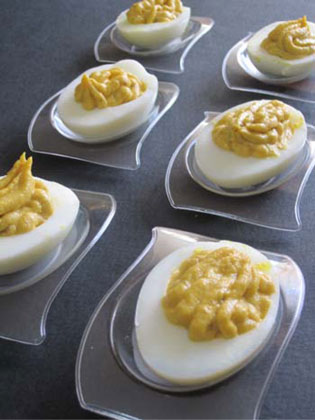 Italians don't make stuffed eggs as often as we do, what with the ever-popular deviled eggs we have. But here's a recipe I like, which is fairly easy, cheap and nutritious. And it doesn't have a particularly fishy taste. If you dress it up, it can be an appetizer. Or it can be a light, cool summer meal, made ahead.
Boil your eggs and cool them. Carefully peel the eggs, keeping the surface of the egg smooth and not dented. Cut in half with a sharp knife, then remove the yolks. Some of them will pop right out, but others will have to be scooped out. Be sure not to break the white while doing this. Gather the yolks and add a nearly equal volume of canned tuna. This time I also added capers (small, nonpareil ones), but that's optional. At this point you can mince with a mezzaluna or even work the mixture with a fork. Some use a food processor. Then add mayonnaise a bit at a time until you get the desired consistency. It should be fairly smooth and moist. Add salt (and pepper, if desired). Be careful if you've added the capers to take that into account.
That's it. Good with a fresh salad with carrots and fennel, crusty bread and white wine. If used as an appetizer, you may try putting little toppings on the eggs, such as a half green olive, a cocktail shrimp, a bit of crunchy cornichon, a thin slice of roasted red pepper, a tiny sprig of dill.
Sunday, June 12, 2011
Google Books and Google Libri
Here's a gold mine of quality information that not many use or even know about. Most people use Google as a search engine only, and only for its first part, the Web. And even then they often don't use advanced search to refine their queries. For shame!
But if you look at the classic Google page you will see various headings after "Web." One of these is Books (you'll have to look under the "more" link). This, as opposed to the Web search, will lead you exclusively to the texts of books and magazines, all of them scanned and digitalized by Google. So that what you have is a way to access published material, much of it recent and copyrighted, and bypass purely Web-generated content. Even now, the average quality of published material is superior to the average quality of Web material, so this is a significant advantage.
When you go to Google Books, you will see that some books (older books not under copyright) are available in their entirety. This is an excellent source for classics. You will find, for example, Machiavelli's Prince in English and Italian, and also Leopardi's poems. But of many other books, even very recent, there is a Preview available, often running even to a hundred or more pages. Using your search keywords, you will be able to find all sorts of info from books and magazines.
Some of the things you can find in Google Books: published recipes of all sorts, some of them by famous chefs and cookbook authors; reliable published travel information, often from magazines and well-known guidebooks; plenty of stuff on the Italian language from regular textbooks and grammars, including exercises; ample extracts from books or authors you're interested in- the equivalent of browsing in a bookstore.
To get to all this, what I usually do is a cross-sectional search. That is, I don't start from the book title or author, I start with relevant keywords e.g. "scampi alla busara recipe" or "Italian imperfect tense" or "Borromean islands." If you know Italian, you will of course input your keywords in Italian, or go to Italian Google (www.google.it) and find the link Libri. But even Google Libri has ample material in English, so that to restrict your results you should still use Italian keywords.
There are other useful features, such as sorting by date (most recent publications first) and a personalized library shelf where you can store your findings. Recently and inevitably, Google has monetized Books, so that you will also be able to buy e-books directly from the site.
Sunday, May 1, 2011
Like gnocchi? Like spinach? Make gnudi
Part of my Sunday was spent experimenting with these little green fellows from Tuscany, called gnudi ("naked"). The shameless little things do indeed go around in a state of undress, like ravioli without their wrapping.

Gnudi are marginally easier to make than potato gnocchi because you don't have to boil, peel and rice the taters. But they're still tricky, as I found.
They're a combination of ricotta, Parmesan cheese and spinach. You will find recipes with varying proportions, and egg is used to bind the mixture. There is some disagreement as to whether flour should be used in the mix itself or just to dredge the gnudi (so they won't be completely naked, scandalizing all and sundry).

Here are some tips from my experience:
1. Use fresh spinach, not frozen. I used baby spinach, cooked and then chopped very finely with my mezzaluna. Spinach should not be watery.
2. Use good quality ricotta.
3. Try to use real parmigiano-reggiano. I used aged parmigiano (stravecchio).
4. Unless you hate nutmeg (and if so, why?), by all means add freshly grated nutmeg. I recently acquired a handy bottle of it with built-in grinder from Drogheria Alimentari.
5. Use good quality butter and sage to dress (so they're not so naked after all...) the gnudi. Avoid elaborate sauces, or even a tomato sauce. I warmed the butter in a pan beforehand, then lightly sauteed the gnudi after they had risen to the top of the boiling water.
6. Avoid making this for company the first time. Experiment. I made them in small batches, varying as I went, and tasting (a lot).
7. The mixture should not be too wet. Resist the temptation to make bigger balls to save time. If the little balls flatten or have fissures, it's a bad sign.
Plenty of recipes can be found on the Web. Here is the one by the ever-active Martha Stewart, which differs somewhat from what I did (she used a food processor for the spinach and used semolina for final dusting).
Subscribe to:
Posts (Atom)